Parents ask me a version of this most weeks, and it is a completely fair question. I brought her in about her head. Why are you checking her hips?
The answer is pure anatomy, and once you have seen it you cannot unsee it.
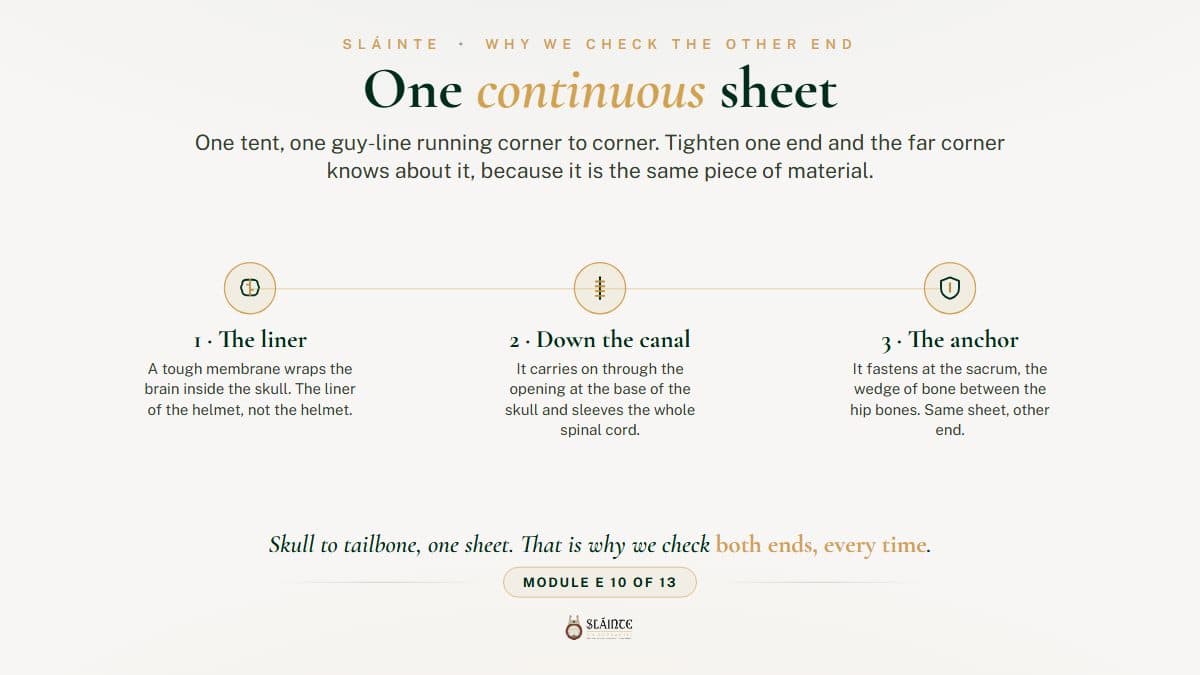
Inside your skull, wrapped around the brain, there is a tough fibrous membrane called the dura mater. Think of it as the liner of the helmet rather than the helmet itself. Leathery, strong, and it holds a shape.
Now here is the part almost nobody gets taught. That liner does not stop at the neck. It continues down through the opening at the base of the skull, runs the whole length of the spinal canal as a sleeve around the spinal cord, and anchors at the bottom end, at the sacrum, the wedge of bone that sits between the hip bones. The fibers of that sheet functionally tie the skull to the spine and to the sacrum.
One sheet. Base of the skull to tailbone. Anchored at both ends.
The picture that fits is a tent. Not the poles, the fabric. One guy-line running corner to corner, pulled taut. Tighten one end and the far corner knows about it immediately, because it is the same piece of material. Nobody has to walk over there and tell it.
Bodies are like that more often than people expect. We are used to thinking in departments. The head is the head, the hips are the hips, and they get separate appointments. Anatomy is less tidy than that, and this is one of the cleanest examples of it in the whole body.
So what I do with that is simple. I check both ends. Every time, on everybody, regardless of which end the question came in about. When a parent hands me a question about a head, the top of the neck and the pelvis are both part of what I look at, because they are connected by a structure that does not care how the question was worded.
I want to be careful about what this does and does not tell you, because it is easy to run further with it than the anatomy allows. This is a description of how a body is built. It is not a claim about what happens when we work on one end of it. Anatomy tells me where to look. It does not tell me what to promise, and I am not going to pretend otherwise.
What it does explain is the shape of the exam. It is why an infant check takes the time it takes and covers more ground than the presenting question suggested. It is why the useful finding is sometimes a long way from where you were pointing. And it is why I would rather look at the whole structure and find nothing at one end than look at half of it and call that thorough.
There is a single sheet running from the base of the skull to the tailbone. That is why I check both ends, every time.
Keep reading: Babies and Development
Individual results vary. Chiropractic care does not diagnose, treat, or cure any disease or condition. This information is educational and not a substitute for medical care. Sláinte provides wellness chiropractic care and works alongside your medical team.
Ready to put this into practice for your family?
Your first visit includes our INSiGHT nervous system scans. X-rays, if clinically necessary, are always discussed with you first.