There is a question almost every parent has and almost none of them ask out loud.
You are standing beside the table watching me look at your three-week-old, making pleasant conversation, and underneath the conversation is the thing you actually want to know. How much of what happens to me is going to happen to her?
Fair question. It is also the most useful thing I can answer in the first visit or two, so I would rather hand it to you before you have to work up to asking.
Here is the answer, and you can test it on yourself before you finish this paragraph.
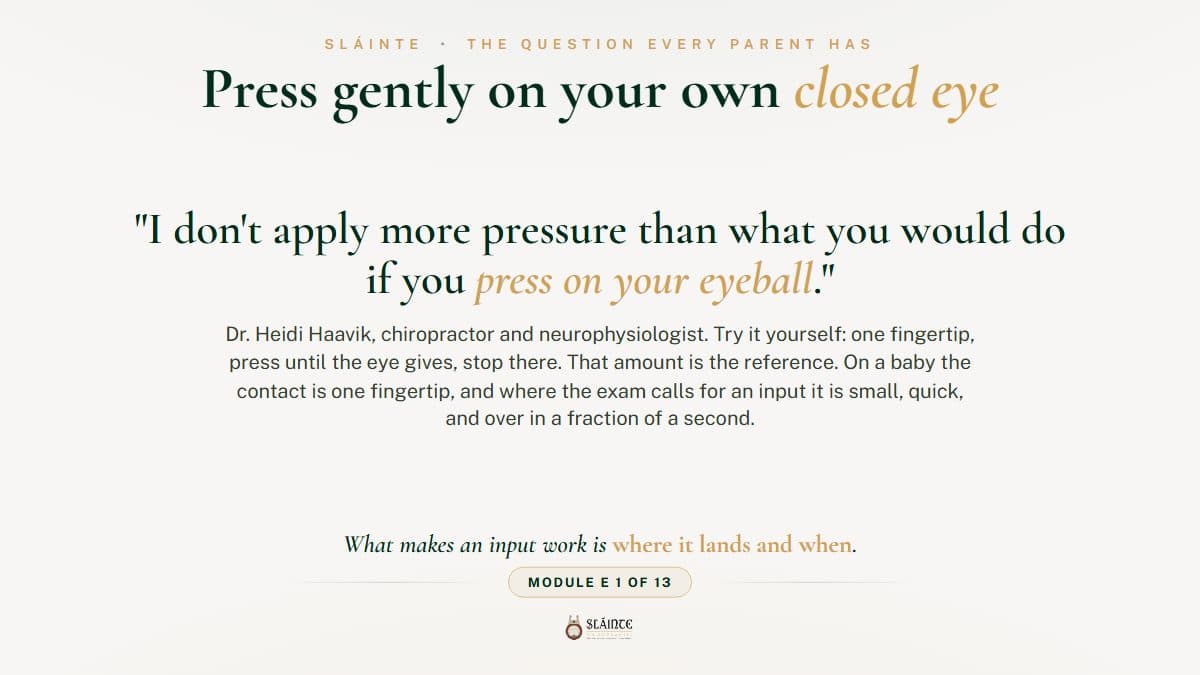
Close one eye. Take your index finger, press gently on the closed lid, and stop the second you feel the eye give underneath it. That amount, right there, is the reference. Dr. Heidi Haavik, a chiropractor and neurophysiologist who has spent her career researching what adjustments do inside the nervous system, puts it in one sentence: "I don't apply more pressure than what you would do if you press on your eyeball."
You just felt it. That is the whole lesson and it took three seconds.
Now let me describe what that looks like in the room, because a number is easier to trust when you can picture the hand.
The contact is one fingertip. Usually the pad of my little finger. Often your baby is on your chest, or over your shoulder, or lying across your forearm mid-feed, because babies do better where they already are and I do not need much room.
The check comes first. I hold that contact long enough to feel two things: whether the tissue gives, and whether the segment moves the way segments that age should move. Most of the appointment is this part. The check is what decides everything after it.
Where the exam calls for an input, it is small, quick and controlled. A specific movement, measured in millimeters, over in a fraction of a second. Parents routinely keep talking straight through it and then ask me when I am going to start.
For scale, hold that next to something your baby already did. Getting through the birth canal is the most mechanically demanding thing most human beings ever do, and that same neck managed it. What happens on our table is a small fraction of that.
Here is the part I actually want you to take home, because it is the reason the number is so small.
Force is not the mechanism. It never was. What makes an input do anything is where it lands and when. The amount required to give a nervous system new information about a joint is nothing like the amount required to move something by strength. A baby's system is brand new and highly responsive to input, so the amount gets dialed down to match the person in front of me. That is what the exam is for. One person, one set of findings, and the findings set the amount.
Which brings me to my favorite thing to be asked. If you are ever curious about what is about to happen to your child, say so, and I will do it on the back of your own hand first so you can feel it. Nobody has ever regretted asking, and a parent who has felt it herself is a parent who can explain it to a grandmother at Thanksgiving.
Press gently on your own closed eye. That is more pressure than I use on a baby.
Keep reading: Babies and Development
Individual results vary. Chiropractic care does not diagnose, treat, or cure any disease or condition. This information is educational and not a substitute for medical care. Sláinte provides wellness chiropractic care and works alongside your medical team.
Ready to put this into practice for your family?
Your first visit includes our INSiGHT nervous system scans. X-rays, if clinically necessary, are always discussed with you first.