Nobody argues about seatbelts.
You buckle your child in every single time, and you have never once wondered whether the strap was holding back their shoulder strength. The seatbelt has one job. It does that job while the car is moving, and the rest of the day belongs to the backyard.
Back sleeping is the seatbelt. Awake belly time is the backyard.
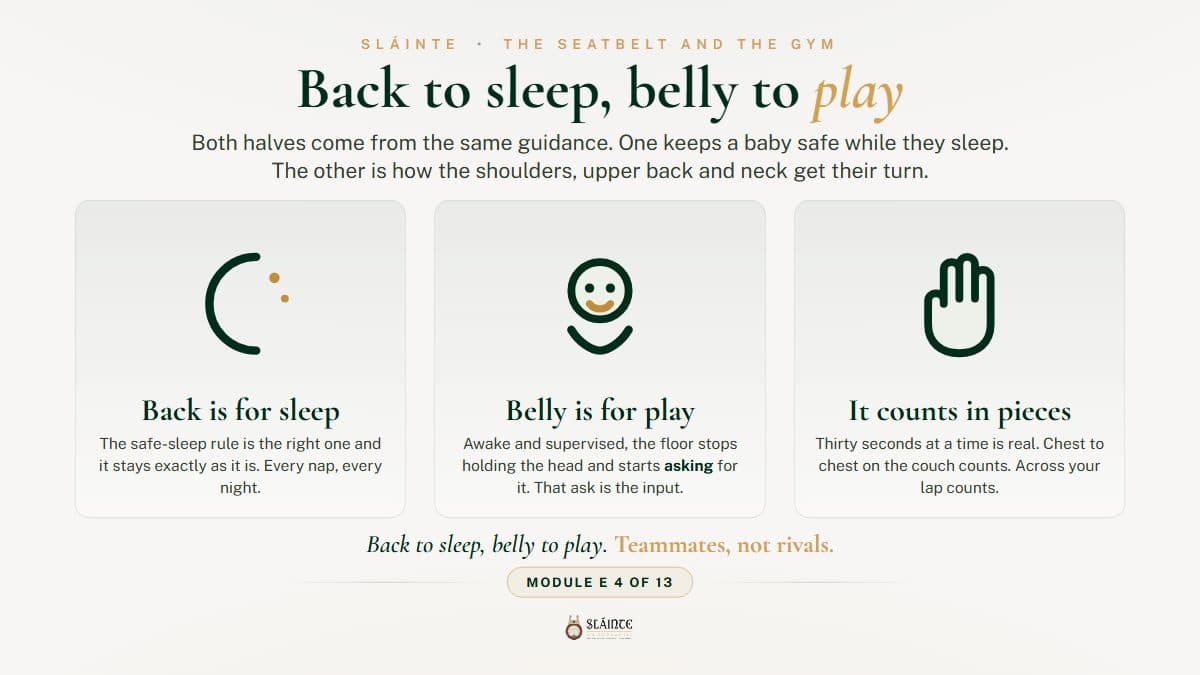
Those two rules sometimes get talked about as though they were in tension, and they are teammates. The safe-sleep guidance is right, we follow it, and the same pediatric guidance that says put a baby down on their back also asks for supervised time on the tummy while the baby is awake. Both halves come from the same place. Both halves are worth having.
Here is the mechanism underneath the second half, because it is more interesting than "babies should do tummy time."
Lying face up is comfortable, and part of why it is comfortable is that the floor is doing the work. The mattress holds the head. It holds the shoulders and the upper back. The muscles that would otherwise be carrying all of that get to sit the shift out. The arms, the shoulders and the upper trunk are simply asked for less on a baby's back.
Flip the same baby over and the whole job changes. Now nothing is holding that head up but the neck. Nothing is propping the chest but the arms. The floor stopped helping and started asking, and asking is the entire point. That is the postural work a baby later spends on sitting, standing and walking, and it is being earned face down on a blanket months ahead of time.
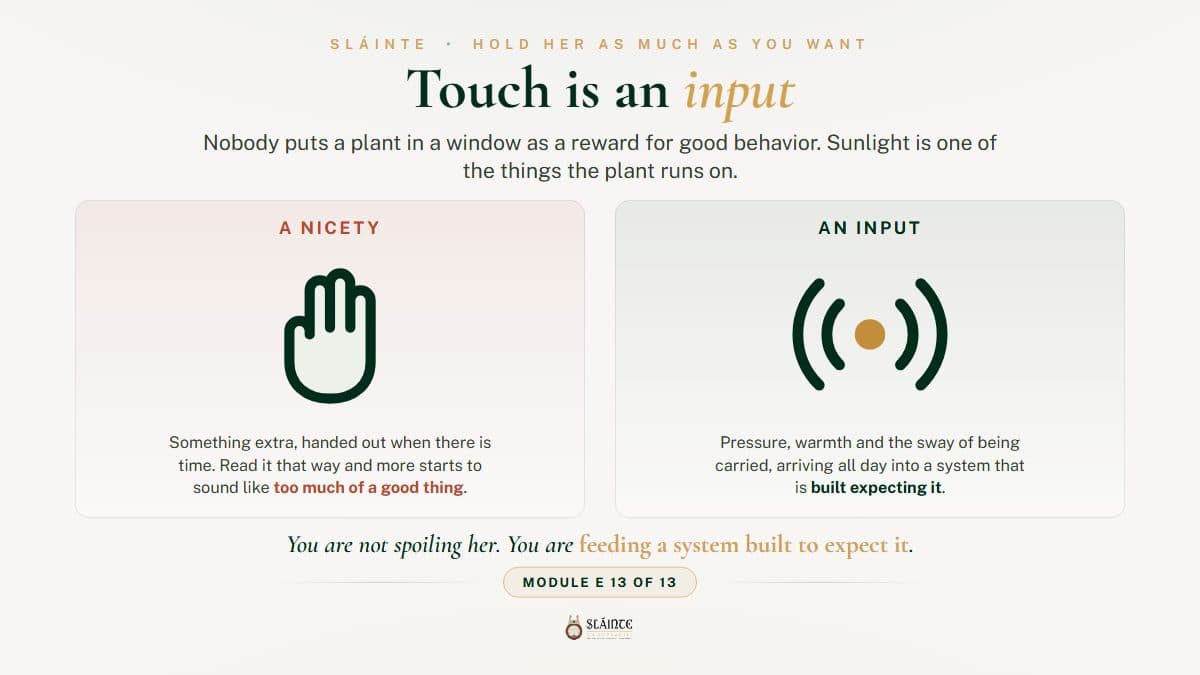
So tummy time is not a box on a checklist. It is an input. It is the gym, and the equipment is a blanket on the floor.
Now the practical part, because almost every parent I talk to says some version of "he hates it, and we are terrible at it."
You are not terrible at it. Almost nobody loves it at the start, and the fix is usually the format rather than the effort.
It counts in pieces. Thirty seconds, six times a day, is a real day of it. Nobody is asking you to run twenty-minute sessions with a stopwatch.
Chest to chest counts. You lie back on the couch, baby lies on you, head up, looking at your face. That is belly time with the best view in the house.
Your lap counts. Across your thighs, one hand on the back, while you are talking to someone. So does the changing table for the minute after a diaper change, when they are already awake and already unbothered.
Get down there with them. On the floor, at eye level, face to face. Most of the protesting is about being alone on a rug, not about the position.
And here is our part in it. When a baby finds one position genuinely hard to hold, that is worth a look rather than more effort. We check how the neck and the upper back are moving, in both directions, and we tell you exactly what we find. Sometimes everything moves freely and the answer really is just reps and patience. Sometimes we find a segment that is not moving well, and restoring that motion is our job. What the body does with it from there is the body's.
Back to sleep, belly to play. Those two rules are teammates, not rivals.
Keep reading: Babies and Development
Individual results vary. Chiropractic care does not diagnose, treat, or cure any disease or condition. This information is educational and not a substitute for medical care. Sláinte provides wellness chiropractic care and works alongside your medical team.
Ready to put this into practice for your family?
Your first visit includes our INSiGHT nervous system scans. X-rays, if clinically necessary, are always discussed with you first.