Picture the spine on the poster in any doctor's office. Curve forward at the neck, back through the ribs, forward again at the low back. That S shape is what everyone means by "a spine."
Your baby did not come with it.
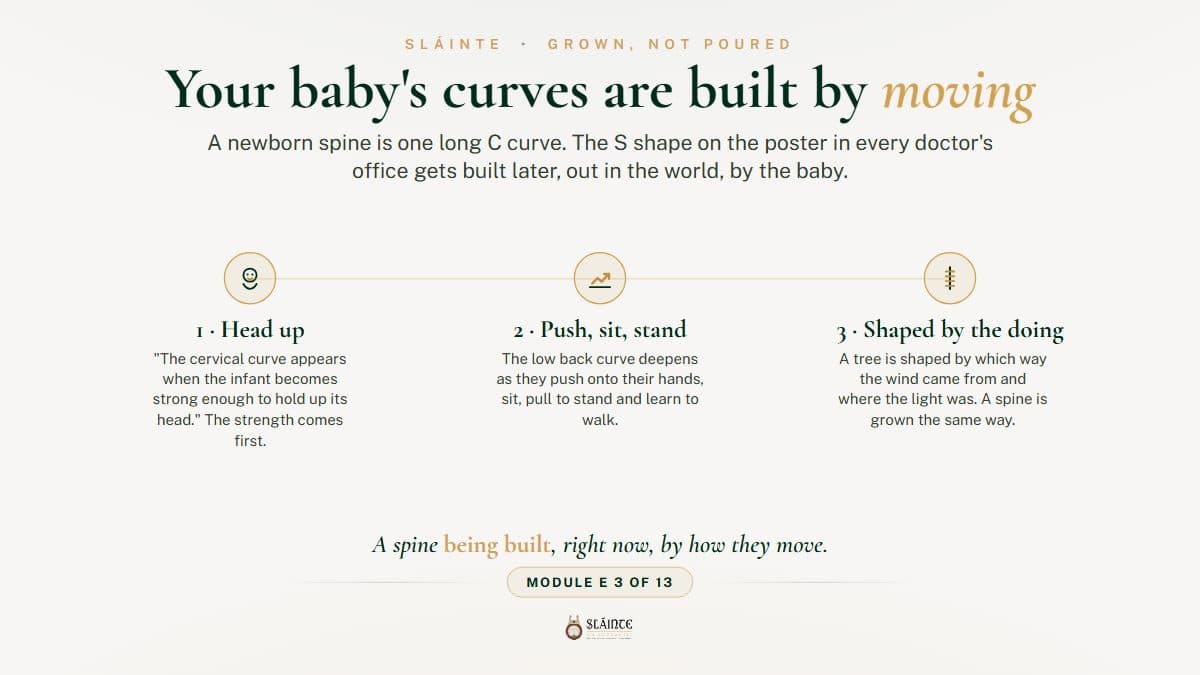
A newborn spine is one long C, curled the way it was curled in utero, and that is exactly correct for a newborn. The curves on the poster get built later, out here, by the baby, using movement. That fact changed how I think about babies more than almost anything else I learned, and it is worth five minutes of yours.
The neck curve comes from lifting the head. It shows up as a baby gets strong enough to hold her own head up, and I want you to read the order in that sentence. The strength is first. The curve is what the strength leaves behind. Every stretch on the floor with the head coming up and wobbling and coming down again is the mechanism, running.
The low back curve comes from pushing up and getting vertical. Onto the forearms, then the hands. Sitting. Crawling. Pulling to stand against the coffee table. Same pattern. The movement comes first and the shape follows it.
So the curves are not parts that shipped with your child. They are closer to a record of what your child has been doing.
The image I keep coming back to is a tree. A spine is not poured like concrete into a form and then left to set. It is grown, over years, shaped by which way the wind came from and where the light was. A tree in the open middle of a field and a tree on a windward slope are both healthy trees. They just carry the record of different conditions in their shape.
Two things follow from that, and I think they land differently on a parent than "protect the spine" does.
First, ordinary movement is not a milestone to tick off. It is the input. Tummy time, floor time, being carried on both sides rather than always the same one, being put down somewhere she has to work a little, unrestricted time out of the seat and the swing and the carrier. None of that is enrichment stacked on top of the real development. That is the development.
Second, what we check is whether the movement is available. I want to be careful here, because this is exactly the place my profession has historically overclaimed. An adjustment does not build a curve and I am not going to tell you it does. What we look at is whether every segment has the motion it should have at that age, and whether your baby turns her head as easily one way as the other, because a baby who finds one direction easier will spend more time in it and do more of her work from there. Where motion is limited, we restore motion. The building is hers to do, on her timing, with her own machinery. We are clearing the way.
Which is honestly the good news in this whole topic. The most important input on the list is free, it happens on your living room floor, and you are already doing it.
Your baby's spine is a thing being built, right now, by how she moves.
Keep reading: Babies and Development
Individual results vary. Chiropractic care does not diagnose, treat, or cure any disease or condition. This information is educational and not a substitute for medical care. Sláinte provides wellness chiropractic care and works alongside your medical team.
Ready to put this into practice for your family?
Your first visit includes our INSiGHT nervous system scans. X-rays, if clinically necessary, are always discussed with you first.