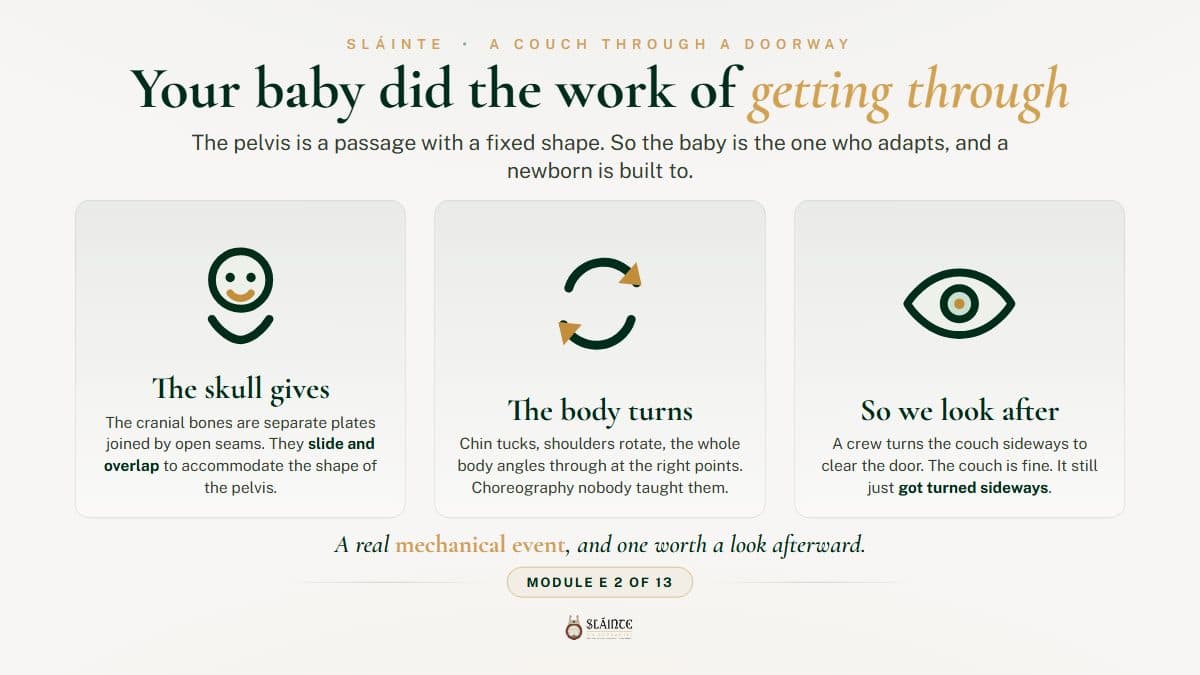
A moving crew gets a couch through a doorway by turning the couch.
The doorway is the doorway. It has one shape and it is not going to negotiate. So everything that happens next happens to the couch: up on one end, angled, walked through at a diagonal by people who have done it a thousand times. And on the other side, the first thing a good crew does is set it down and square it up.
The couch is fine. It also just got turned sideways.
That is about the most honest picture I have for what your baby did on the way here, and I want to walk through it properly, because it is one of the more remarkable pieces of engineering in the human body and it almost never gets described to the people who lived through it.
Your pelvis is a passage with a fixed shape. It gives a little, and pregnancy hormones give it a little more, but fundamentally it is bone and it is the shape it is.
So your baby is the one who adapts. And a newborn is built to. That skull is not one solid dome. It is separate plates joined by seams, and the seams are open on purpose, so the bones can slide and overlap each other and let the head narrow itself to the space available. That is not a failure of the design. That is the design.
And it is not only the head. The chin tucks. The shoulders rotate to line up with the widest part of the passage. The whole body angles, extends and turns, at the right points, in the right order. It is choreography, and nobody taught it to your baby.
So here is what I mean when I say birth is a mechanical event. Not a rough one. Not a damaging one. A mechanical one, in the ordinary sense that real forces moved through a real body in a real direction, and the body they moved through is the newest one in the house.
Now I want to be plain about something, because I have had this conversation enough times to know where it goes.
This is not a story about your birth. I am not grading it. I am not reading anything backwards into it. And I am not going to sit here and tell you that something about how your child arrived caused something you are worried about now. I do not know that. Nobody does. And it would be a rotten thing to put on a mother.
Every route through is a route through. Whatever yours looked like, the work your baby did is the same category of work, and so is yours.
What I am saying is much smaller and much more practical. Something physical happened. When something physical happens to a body, checking it afterward is a reasonable thing to do.
That is all a newborn check is. We look at how the neck moves, how the head turns each way, what the tissue is doing, how the whole thing sits. It takes a few minutes, and it is the same fingertip pressure as everything else we do at that age.
Nothing about that check assumes something went wrong. We check because it is quick, because it is gentle, and because it is better information than guessing.
Your baby did not just get delivered. Your baby did the work of getting through, and that is worth a look afterward.
Keep reading: Babies and Development
Individual results vary. Chiropractic care does not diagnose, treat, or cure any disease or condition. This information is educational and not a substitute for medical care. Sláinte provides wellness chiropractic care and works alongside your medical team.
Ready to put this into practice for your family?
Your first visit includes our INSiGHT nervous system scans. X-rays, if clinically necessary, are always discussed with you first.