Watch a baby feed and it looks like the calmest thing in the world.
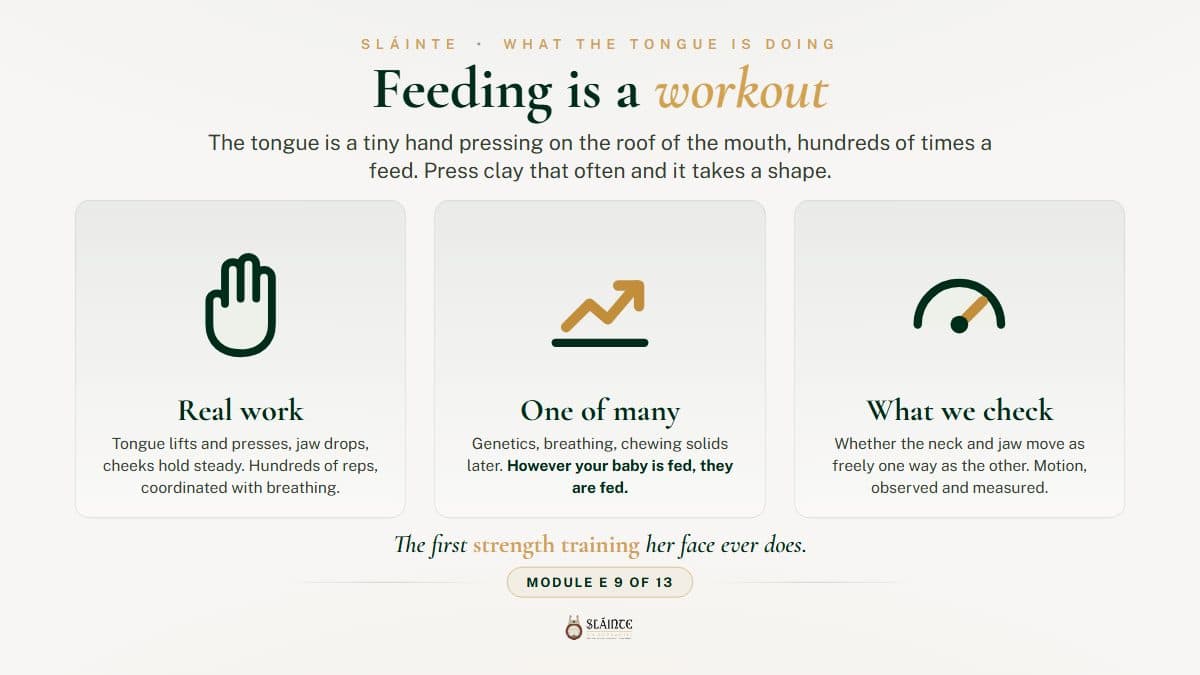
It is not. Underneath that quiet there is a surprising amount of work going on. The tongue lifts and presses. The jaw drops and closes. The cheeks stabilize. That sequence repeats hundreds of times in a single feed, and it stays coordinated with breathing and swallowing the whole way through, which is a piece of timing most adults could not pull off on purpose.
Here is the part most parents have never been told. That effort is not only how milk moves. It is also, I think, one of the forces that shapes the face.
The way I understand it, the tongue acts on the growing upper and lower jaw in something close to the way an orthodontic appliance does. Rhythmic pressure against the palate, over and over, for months. Same idea, different source of force. Not a wire. A tongue.
The picture I use is clay. The tongue is a tiny hand pressing up on the roof of the mouth. Press clay that often, that gently, that regularly, and it takes a shape. Nobody had to push hard, and nothing about it happened in a day.
Two things I want to say clearly before the practical part, because this is a subject that gets handled badly and I would rather be plain.
However your baby is fed, they are fed. Nursing, bottle, both, exclusively pumped, formula, or some arrangement that changed three times in the first month. A bottle asks the tongue and the jaw to work too. And a face gets shaped by a long list of things over a long stretch of time: genetics first, then breathing, then chewing solids, then two decades of ordinary use. This is one input among many, and it is not a verdict on any decision you have made.
And what happens in my office here is a check on motion. That is the honest size of it.
Feeding takes movement. To feed comfortably on both sides, a baby has to turn her head easily in both directions, extend and tuck the neck, and open the jaw freely. Those are movements, and movements can be observed and measured. So part of what I look at when a parent brings me a baby is whether the neck and the jaw move as well one way as the other, and whether anything is restricted.
Where I find a segment that is not moving the way it should, I restore the motion, and her body takes it from there. That is the whole claim, and it is a smaller one than it probably sounds like it should be.
What you can do at home is just notice. Does she turn as easily to the left as to the right? Is one side comfortable and the other side a wrestling match? That is not a diagnosis and it is not a reason to worry. It is an observation, it costs nothing, and it is genuinely useful to me.
Feeding is not just calories. It is the first strength training your baby's face ever does.
Keep reading: Babies and Development
Individual results vary. Chiropractic care does not diagnose, treat, or cure any disease or condition. This information is educational and not a substitute for medical care. Sláinte provides wellness chiropractic care and works alongside your medical team.
Ready to put this into practice for your family?
Your first visit includes our INSiGHT nervous system scans. X-rays, if clinically necessary, are always discussed with you first.